
TFT and IPS Display: How the Two Actually Relate
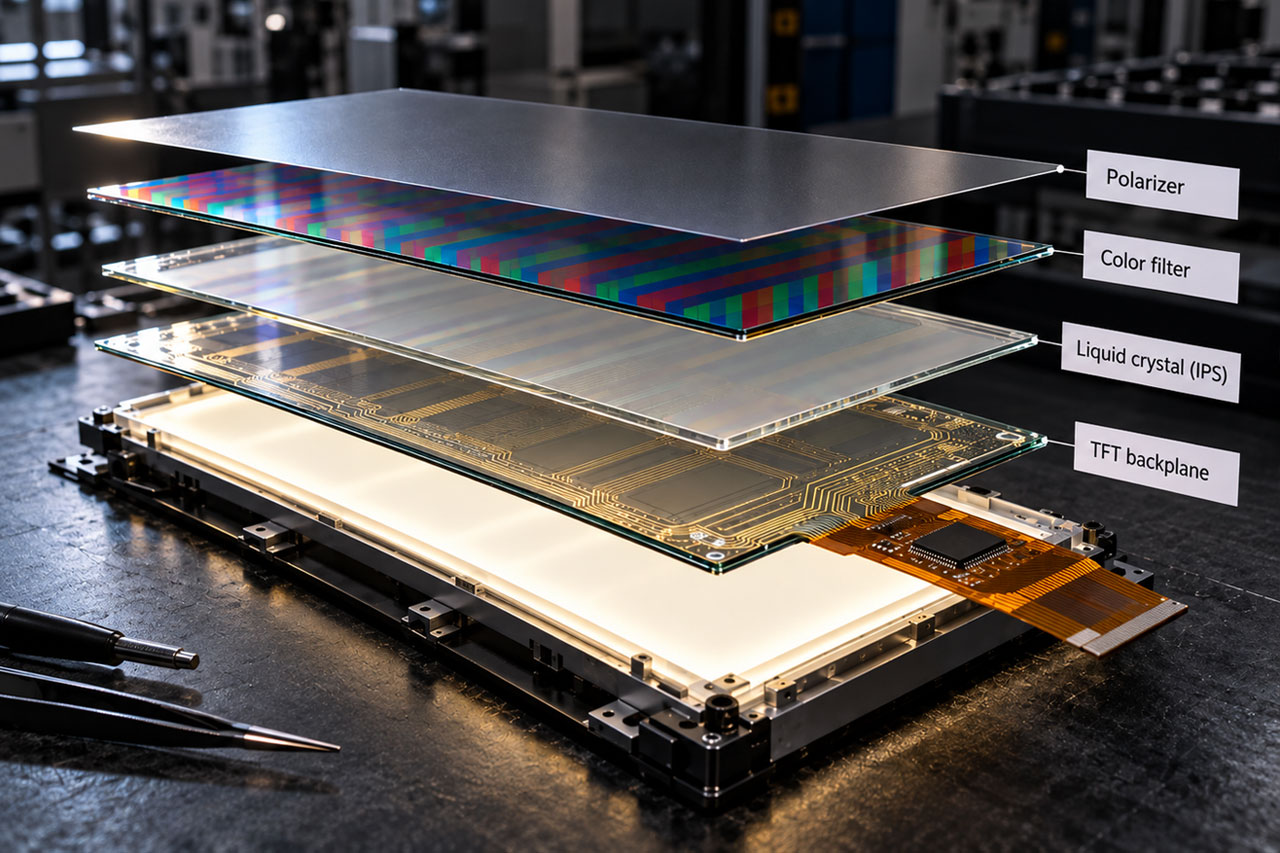
Search for “TFT vs IPS” and you will find dozens of comparison tables with the two names in opposite columns, as if a display had to be one or the other.
It does not. A TFT and IPS display is not a choice between two technologies, because TFT and IPS answer different questions.
TFT — thin-film transistor — is the backplane: a grid of switches, one per pixel, that decides when each pixel is charged. IPS — in-plane switching — is the liquid crystal mode: the arrangement of electrodes and molecules that decides how light is modulated once the pixel is charged.
An IPS display is a TFT display. So is a TN display, and so is a VA display. The real decision is two decisions: which backplane, and which crystal mode. If you want the full catalogue of panel types first, start with our guide to the Types of LCD Displays; this article focuses on how TFT and IPS relate and how to specify them.
The Short Answer: Same Stack, Different Layers
The difference between TFT and IPS display is a difference of layer, not of quality. TFT is the backplane — one thin-film transistor per pixel that decides when the pixel is charged. IPS is the liquid crystal mode — the electrode and molecule arrangement that decides how light passes through. Every IPS display is a TFT display, and so is every TN and VA display. The real choice is which backplane (a-Si, IGZO or LTPS) and which crystal mode (TN, IPS or VA).
Five questions, five short answers
| Question | Answer | Why |
|---|---|---|
| Is an IPS display a TFT display? | Yes | IPS needs a TFT backplane to switch each pixel |
| Is TFT a type of IPS? | No | TFT only switches the pixel; it does not set how the crystal rotates |
| Are TN and VA panels TFT displays? | Yes | Any active-matrix LCD uses a TFT backplane |
| What does "TFT LCD" usually mean? | A color active-matrix LCD | Historically used to contrast with passive-matrix STN |
| What does "IPS LCD" emphasise? | Wide viewing angle and stable color | It names the crystal mode, not the backplane |
So when people ask about the difference between IPS and TFT display, the accurate answer is that they are asking about two different layers of the same panel.
TFT decides when a pixel lights. IPS decides from which angle it still looks right.
What “TFT” Actually Means: The Backplane
In every active-matrix LCD, each pixel has a thin-film transistor and a small storage capacitor at its corner. The transistor works like a gate: during each frame it opens to charge the pixel to the required voltage, then closes so the charge holds until the next frame. That is all “TFT” describes — and it says nothing about how the liquid crystal above it behaves.
What TFT does decide is how fine, how fast and how frugal a display can be. That depends on the semiconductor the transistors are made from:
The four main TFT backplanes
| Backplane | Electron mobility (approx.) | Resolution capability | Power behaviour | Cost | Typical use |
|---|---|---|---|---|---|
| a-Si (amorphous silicon) | ~0.5–1 cm²/V·s | Moderate | Higher leakage, needs regular refresh | Lowest | Most small and mid-size TFT modules, TVs, monitors |
| IGZO (oxide) | ~10–50 cm²/V·s | High, including large high-resolution panels | Very low leakage, so static images can be held at low refresh | Medium | High-resolution LCDs, tablets, IT panels |
| LTPS (low-temperature polysilicon) | ~100–200 cm²/V·s | Highest, 500+ PPI | Efficient driving, but higher leakage than oxide | Highest | Smartphones, high-PPI small displays |
| LTPO | LTPS drive + oxide switching | High PPI | Supports very low refresh rates for static content | High | Flagship phones and watches (mainly OLED) |
“TFT” is therefore a family, not a grade — and it is the half of the TFT and IPS display difference that most comparison tables leave out. Two datasheets that both say “TFT LCD” can describe backplanes whose transistor mobility differs by two orders of magnitude.
The backplane sets how fine, how fast and how frugal a screen can be. It does not set the viewing angle.
What “IPS” Actually Means: The Crystal Mode
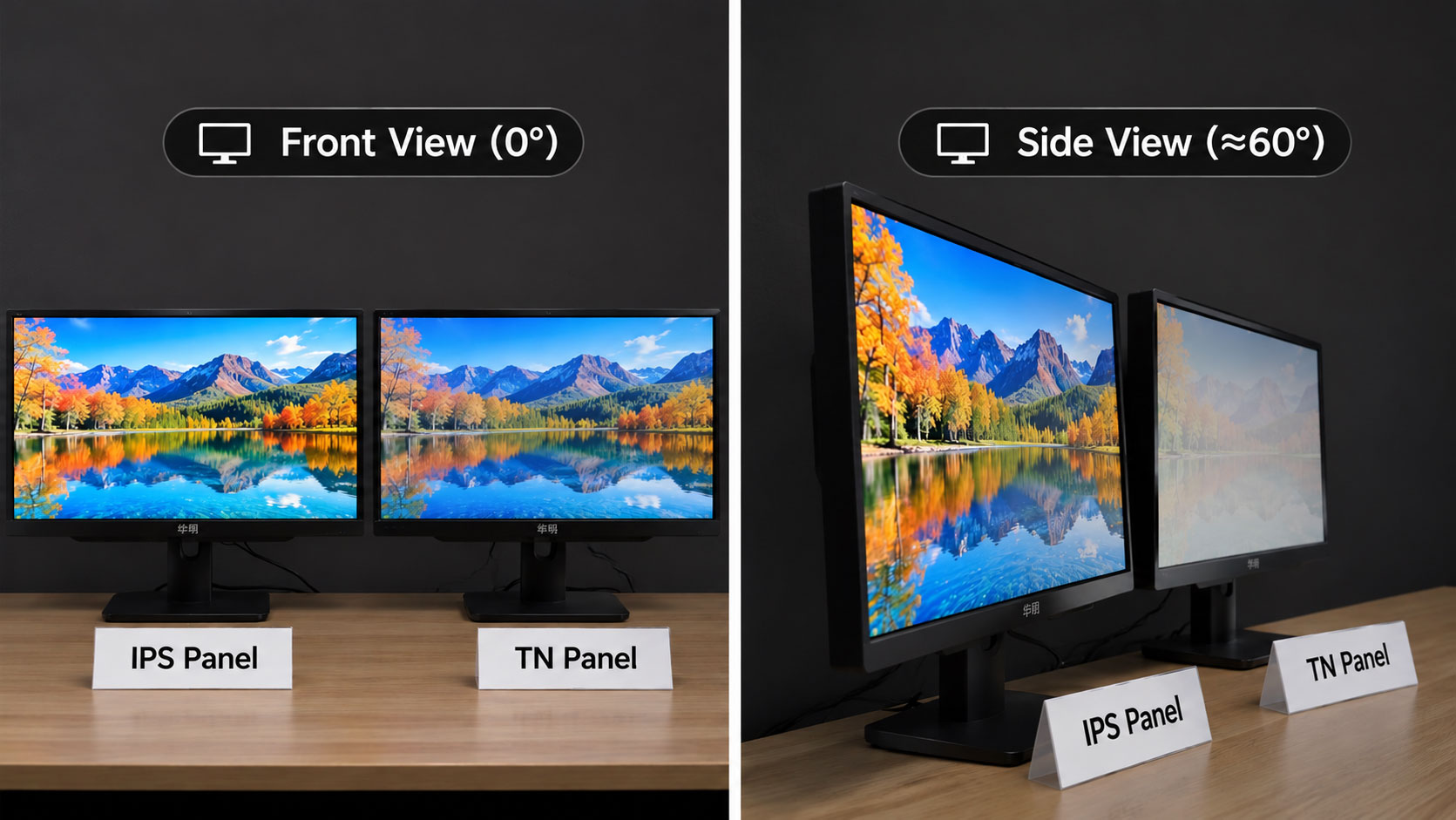
The other half of any TFT and IPS display is the crystal mode. In an IPS cell, the pixel electrode and the common electrode sit side by side on the same glass substrate. When voltage is applied, they create an electric field that runs parallel to the glass, and the liquid crystal molecules rotate within that plane — hence “in-plane switching”.
TN and VA work differently. Their electrodes sit on opposite substrates, the field runs vertically through the cell, and the molecules tilt up or lie down.
- Why the viewing angle is wide: because the molecules turn in the plane of the glass, the optical path changes little when the display is seen from the side, so color and brightness shift less. Datasheets commonly state 178° horizontal and vertical, or “Full View”.
- Normally Black: IPS panels are usually normally black — with no voltage applied, the molecule alignment blocks light at the output polarizer and the pixel is dark.
- The trade-offs: some light leaks at steep angles on dark content (often called “IPS glow”), native contrast is usually lower than VA, and transmittance is typically lower than TN.
IPS is not a “better TFT”. It is a liquid crystal mode that makes the molecules turn sideways.
Why the Confusion Exists: A Short History of Two Labels
How the two labels drifted
| Period / context | What "TFT" came to mean | What "IPS" came to mean |
|---|---|---|
| 1990s–2000s | Active-matrix color, as opposed to passive-matrix STN | A wide-viewing-angle technology commercialised by Hitachi in the mid-1990s |
| 2010s phone and monitor marketing | Shorthand for an ordinary LCD | Shorthand for a "good screen" |
| Procurement today | Should be read as the backplane type | Should be read as the crystal mode |
That is why searches for the difference between IPS and TFT display return so many tables comparing the wrong things. The result is that two words describing different layers ended up in the same comparison table. Comparing them directly is like asking whether a car is better than an automatic gearbox.
How to Read the Datasheet: “IPS, Normally Black”
Most TFT module datasheets, including our own product pages, list something like this:
A typical datasheet entry
| LCD type | IPS, Normally Black |
|---|---|
| Resolution | 360 × 360 |
| Viewing direction | Full View |
| Interface | QSPI |
The “LCD type” line describes the crystal mode, because the backplane is assumed to be TFT — on an IPS display and TFT display datasheet alike, the backplane itself is rarely stated. What it does and does not tell you:
What “IPS, Normally Black” tells you — and what it leaves out
| The line tells you | The line does not tell you |
|---|---|
| The crystal mode is IPS | Whether the backplane is a-Si, IGZO or LTPS |
| The panel is dark with no voltage applied | Transmittance, and therefore backlight current |
| A wide viewing angle is likely | The typical contrast ratio |
| — | Which IPS variant is used (IPS, ADS, FFS) |
When comparing an IPS display and TFT display specification from two suppliers, ask for the four missing items: backplane type, typical contrast, transmittance or backlight current, and IPS sub-type.
“IPS” sits in the mode column, not the backplane column. The column the datasheet leaves blank is the one to ask about.
IPS vs TN vs VA: Compare on the Right Axes
Once the backplane is set aside, the comparison people expect from a difference between IPS and TFT display search is really a comparison between crystal modes. The figures below are typical ranges; individual panels vary.
TN, IPS and VA crystal modes compared
| Axis | TN | IPS | VA |
|---|---|---|---|
| Viewing angle | Narrower, with a preferred direction (often listed as 6 or 12 o'clock) | Wide, typically 178°/178°, smallest color shift | Wide on paper, but contrast and color shift off-axis |
| Native contrast | Around 1,000:1 | Around 1,000:1; newer "IPS Black" panels around 2,000:1 | Highest, typically 3,000:1 or more |
| Response time | Fastest | Moderate to fast | Slower in dark transitions, which can smear |
| Color | Shifts with angle | Most stable across angles | Good head-on, shifts off-axis |
| Transmittance / backlight demand | Higher transmittance | Lower; needs more backlight for the same brightness | Medium |
| Cost | Lowest | Higher | Medium |
Color gamut — how saturated the reds, greens and blues can be — is set mainly by the backlight and color filters, not by the crystal mode. A wide-gamut claim should be checked against the backlight specification, whichever mode is used.
IPS wins on angle, VA wins on black, TN wins on speed and price.
The IPS Family: Not All IPS Is the Same
Common IPS variants
| Name | Key point |
|---|---|
| S-IPS / AS-IPS | Early refinements improving response and transmittance |
| H-IPS / e-IPS | Later generations with different cost and performance balances |
| AH-IPS | Oriented toward higher transmittance and resolution |
| ADS / FFS | Fringe-field switching modes in the IPS family; widely used by Chinese panel makers, with wide viewing angles and good transmittance |
| IPS Black | Improved contrast, around 2,000:1 |
| Fast IPS | Response-optimised for gaming monitors |
Because different makers use “IPS” for different sub-technologies, two panels both labelled “IPS” can differ noticeably in contrast and transmittance. If it matters to your product, lock the sub-type in the specification.
IPS is a family name, not a part number.
The Hidden Cost of IPS: Transmittance and Backlight Power
The chain is physical. IPS electrodes take up part of each pixel’s area, which lowers the aperture ratio, which lowers transmittance. Lower transmittance means the backlight must work harder to reach the same brightness — and in an LCD module, the backlight is already the largest share of power.
That does not make every TFT and IPS display power-hungry. Backlight driver efficiency, PWM dimming, interface choice and sleep strategy can close the gap, as we explain in our guide to low power LED and LCD displays. For battery products showing mostly static information, look at low-power options first; for products where color and viewing angle matter, the IPS power premium is usually worth paying.
IPS buys its viewing angle with backlight power — and good system design can buy most of it back.
When IPS Is the Right Choice, and When It Is Not
Choosing a crystal mode by application
| Application | Usually best | Why |
|---|---|---|
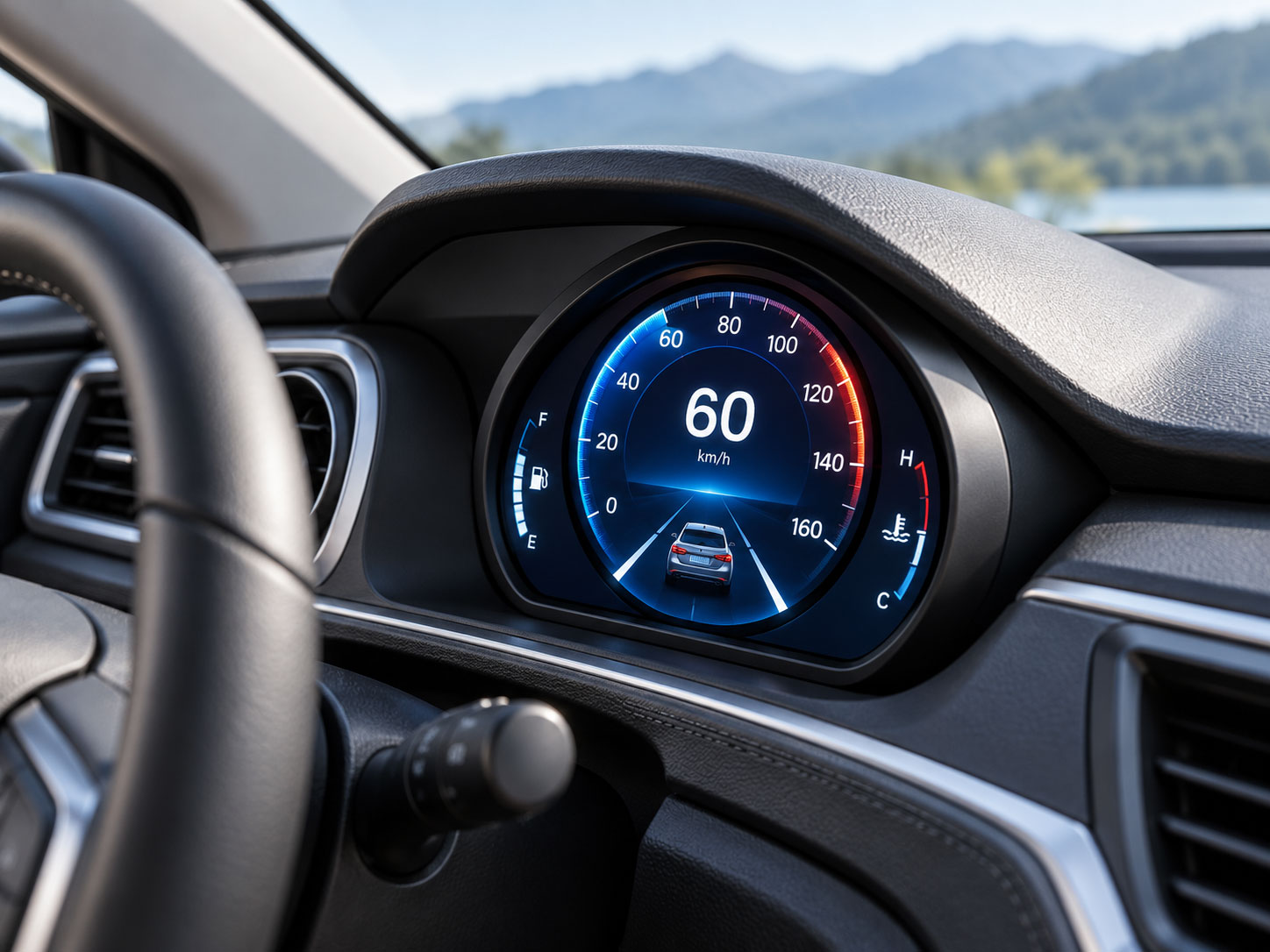
| Automotive clusters and center displays | IPS | Read from several seats and angles; stable color |
| Industrial HMI and medical devices | IPS | Consistent readings from any operator position |
| Outdoor and bright light | IPS with high brightness or transflective design | Viewing angle plus readability |
| Round, square and bar-type small displays | IPS | Viewing-angle problems are most visible on small, tilted screens |
| Dark-room media and TVs | VA | Highest contrast |
| Lowest cost, simple content | TN or STN | Cost first, fixed viewing direction acceptable |
| Very high PPI or ultra-low static power | LTPS or IGZO backplane with a suitable mode | The backplane sets the ceiling |
First ask who is looking and from where. Then ask about dark scenes. Price comes last.
Specifying TFT and IPS in a Purchase Order: A Checklist
Ten items to write into the specification
| # | Specify | Why |
|---|---|---|
| 1 | Backplane type (a-Si, IGZO, LTPS) | Sets the ceiling for resolution, refresh and static power |
| 2 | Crystal mode and sub-type (IPS, ADS, FFS) | Sub-types differ in contrast and transmittance |
| 3 | Resolution and PPI | Must match the backplane's capability |
| 4 | Brightness (nits) and typical contrast | Only comparable under the same conditions |
| 5 | Viewing angle and its definition | 178°" depends on the contrast threshold used, usually CR ≥ 10 |
| 6 | Transmittance or backlight current | Determines power |
| 7 | Interface (QSPI, SPI, RGB, MIPI, LVDS) | Must match the host controller |
| 8 | Operating temperature | Critical for automotive and industrial use |
| 9 | Normally black or normally white | Affects the powered-off appearance and driving |
| 10 | Uniformity and color-difference limits | Keeps production batches consistent |
Whatever the specification leaves out, the supplier is free to choose.
Why Huaming: IPS Modules Specified Layer by Layer
Jiangxi Huaming Wisdom Display Technology Co., Ltd. is a TFT LCD Module Manufacturer building modules from 0.96 to 10.1 inches in IPS, TN and MVA types, in an IATF 16949 certified factory in Shanggao, Jiangxi.
Because IPS is a mode and TFT is a backplane, we specify both:
- IPS normally-black panels across round (1.46″, 3.6″), square (1.8″, 3.95″), bar-type (2.86″, 3.69″), portrait and in-cell touch formats
- TN and MVA alternatives where cost or contrast matters more than viewing angle
- QSPI, SPI, RGB, MIPI and LVDS interfaces matched to your controller and update pattern
- Optical bonding for touch and cover-glass versions, to protect contrast and viewing angle
- Backplane type, contrast and backlight current confirmed in writing for your project
For every TFT and IPS display module we build, tell us the viewing environment, the contrast you need and your interface. We will confirm the mode, the backplane and the backlight together as a Custom LCD Display — not just print “IPS” on the drawing.
Frequently Asked Questions
Is IPS a type of TFT?
Yes, more precisely IPS is a liquid crystal mode that runs on a TFT backplane. Every IPS display is an active-matrix TFT display, but not every TFT display is IPS — TN and VA panels use TFT backplanes too.
What is the difference between TFT and IPS display?
They describe different layers. TFT is the backplane, one transistor switch per pixel, which sets resolution, refresh rate and static power. IPS is the liquid crystal mode, which sets viewing angle, contrast and color stability. Comparing them directly is like comparing an engine with a gearbox.
Is IPS better than TFT?
The question does not quite work, because IPS displays are TFT displays. The useful comparison is IPS against TN and VA: IPS leads on viewing angle and color stability, VA on contrast, and TN on response time and cost. The TFT backplane then decides how high the resolution and how low the power can go.
Why does the datasheet say “IPS, Normally Black”?
“IPS” fills the crystal-mode field and “Normally Black” means the pixel is dark with no voltage applied. The line does not state whether the backplane is a-Si, IGZO or LTPS, nor the transmittance or contrast — those should be requested separately.
Is IPS more power-hungry than TN?
Usually somewhat, because IPS has lower transmittance and needs more backlight for the same brightness. Efficient backlight drivers, PWM dimming, a suitable interface and deep sleep can narrow the gap considerably, so the result depends on system design as much as on the panel mode.
What are ADS and FFS? Are they IPS?
They are fringe-field switching modes in the IPS family, working on the same in-plane principle. They are common among Chinese panel makers and offer wide viewing angles with good transmittance. If a specification only says “IPS”, different suppliers may deliver IPS, ADS or FFS, so lock the sub-type in writing.
Which is better for automotive or industrial displays?
In most cases IPS, for its wide viewing angle and stable color from several positions. VA can suit applications dominated by dark content, and TN or STN can suit very cost-sensitive segment displays. The final choice depends on the viewing environment, temperature range and service life.
Summary of the TFT and IPS display difference: TFT is the switch behind every pixel; IPS is one of several ways to arrange the crystal in front of it. Specify both, separately.