
Types of LCD Displays: TN, STN, TFT, IPS and LCM
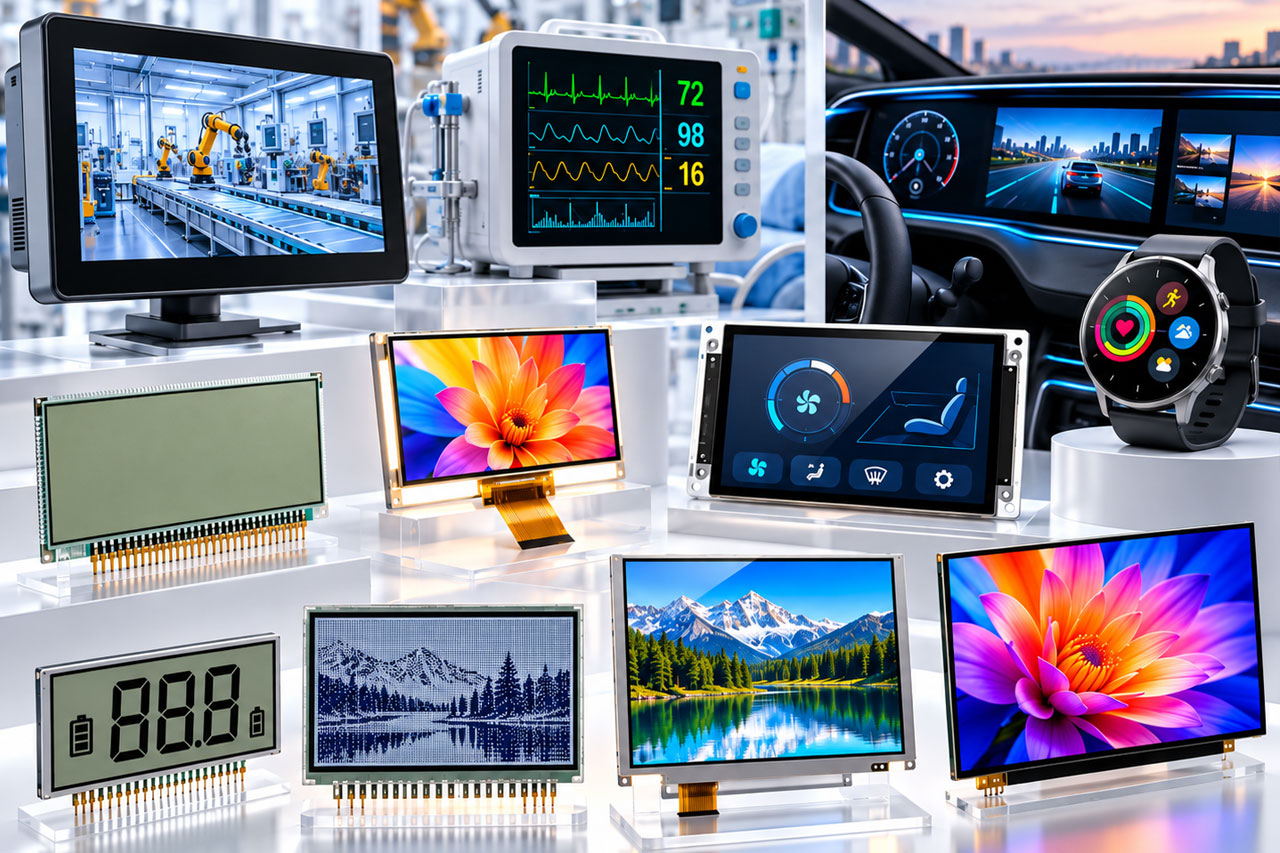
LCD displays can be classified in two ways. By level of integration, there are three product types: bare LCD glass, the LCD module (LCM), and the smart display or LCD terminal. By liquid crystal technology, the main types are TN, STN, and TFT — with TFT further divided into TN, IPS and VA/MVA panels. Which one you need depends on your controller, your production volume and how the display will be viewed.
This guide walks through both classifications, with comparison tables you can use when specifying a display.
Three Levels of LCD Product
LCD glass
LCD glass is the most basic form of an LCD: a glass panel with the liquid crystal sealed inside and electrodes brought out to the edge. It contains no driver IC and no controller. On the open market, bare glass sold directly to end users is limited to low-density segment displays — the kind used in calculators, meters and simple appliance panels — where an external driver or microcontroller handles the drive signals.
LCD module (LCM)
An LCD module, usually shortened to LCM, combines the glass with a driver IC (and in most designs a backlight and FPC) into one assembly. It presents a standard interface to the host system — historically 4-bit or 8-bit parallel buses, and today SPI, QSPI, RGB, MIPI or LVDS — and the host controls the display through that interface.
An LCM is far easier to integrate than bare glass. For small displays, it connects directly to a microcontroller. But as resolution and color depth grow, the data the host must push becomes the limiting factor.
Why bandwidth matters — a worked example. Take a 320×240 color module at 8 bits per pixel (256 colors), refreshed 20 times per second:
320 × 240 × 8 bits × 20 frames = 12.3 Mbit/s, or about 1.5 MB/s
That is well beyond what a classic 8-bit microcontroller such as an 8051 can stream while also running its application. It is the reason higher-resolution modules use dedicated interfaces such as RGB, MIPI or LVDS driven by an application processor, while low-pin-count interfaces like SPI and QSPI suit small displays on modest controllers.
Smart display (LCD terminal)
A smart display, sometimes called an LCD terminal, integrates everything needed to show content: the LCM, a graphics controller, memory and often touch and keypad interfaces. Because rendering happens inside the display, the host only needs a slow serial link — typically UART — to send commands such as “show screen 3” or “update this value”. This removes most display firmware work from the product team, which is why smart displays are common in POS terminals, banking and logistics equipment, and project-based systems.
A useful analogy from desktop computing: LCD glass is the bare screen panel, an LCM is the monitor, and a smart display is the monitor plus graphics card plus motherboard.
Comparison: LCD glass vs LCM vs smart display
| LCD glass | LCD module (LCM) | Smart display | |
|---|---|---|---|
| What it includes | Glass panel only | Glass + driver IC (+ backlight, FPC) | LCM + controller + memory + interfaces |
| Host interface | Direct segment drive | SPI, QSPI, MCU, RGB, MIPI, LVDS | Serial (e.g. UART) |
| Host workload | High | Medium to high | Low |
| Unit cost | Lowest | Low to medium | Highest |
| Development effort | High | Medium | Lowest |
| Best for | Simple segment displays | Volume products with cost pressure | Low-to-mid volume and project work |
Which level should you choose?
- LCD glass suits segment-style, cost-driven designs where an external driver or MCU is acceptable.
- An LCM suits products built in volume, where unit cost dominates and the engineering effort is spread across many units.
- A smart display suits low-to-medium volumes and project applications. As a rule of thumb, below around 1,000 units a year, the development time and lost time-to-market of a custom LCM design can make it cost as much as a smart display — or more.
How an LCD Works
Liquid crystal is a state of matter between solid and liquid. It flows like a liquid but keeps the optical anisotropy of a crystal — light passing through it behaves differently depending on molecular orientation — and that orientation can be changed with an electric field.
Displays use thermotropic liquid crystal, which shows liquid crystal behavior only within a temperature range. Below it, the material crystallizes; above it, it becomes an ordinary liquid. This is why every LCD datasheet lists an operating and storage temperature range.
Key characteristics of LCD technology
- Low voltage and low power — the liquid crystal itself draws very little current.
- Flat, thin construction.
- Non-emissive — the liquid crystal modulates light rather than producing it, using a backlight or ambient light.
- High information density — pixels can be made very small.
- Accurate color reproduction with color filters.
- Very low electromagnetic emission compared with older CRT displays, and no X-ray radiation.
- Long panel life — the liquid crystal panel itself degrades very little; in practice the backlight sets the module’s service life.
Types of LCD by Liquid Crystal Technology
TN (Twisted Nematic)
A TN cell sandwiches a layer of liquid crystal between two glass substrates coated with transparent electrodes. The molecules lie parallel to the glass and twist through 90° from top to bottom. Polarizers are added on both sides, plus a reflector on the back for reflective designs. TN is simple and low-cost, and it remains common in segment displays and cost-sensitive TFT panels.
STN (Super Twisted Nematic)
STN uses the same basic structure, but the molecules twist through 180° to 270° instead of 90°. The steeper electro-optical response lets STN drive more rows and columns than TN, which made it the standard for monochrome and early color dot-matrix displays.
Both TN and STN in their classic form are passive matrix displays: pixels are selected by applying voltage across row and column electrodes. As rows increase, the required drive voltage rises and each pixel — effectively an unswitched capacitor — becomes prone to crosstalk. This limits passive-matrix displays to modest resolutions and makes smooth video impractical.
TFT (Thin Film Transistor)
A TFT LCD places a transistor switch at every pixel, forming an active matrix. Each pixel is held at its own voltage independently of its neighbors, which eliminates crosstalk and enables high resolution, true color and smooth motion. TFT is now the standard for color displays.
Within TFT, the liquid crystal mode determines viewing performance:
- TFT-TN — the lowest-cost TFT type, with a preferred viewing direction (often listed as “6 o’clock” or “12 o’clock” on datasheets).
- IPS (In-Plane Switching) — molecules rotate parallel to the glass, giving wide, symmetric viewing angles and stable color. Usually listed as “Full View”.
- VA / MVA (Vertical Alignment / Multi-domain VA) — high contrast with wide viewing angles, widely used where deep blacks matter.
Comparison: TN vs STN vs TFT panel types
| Type | Matrix | Color | Viewing angle | Typical use |
|---|---|---|---|---|
| TN (segment) | Passive or direct drive | Monochrome | Narrow | Meters, calculators, appliances |
| STN | Passive | Mono or limited color | Moderate | Older dot-matrix displays |
| TFT-TN | Active | Full color | Directional | Cost-sensitive color displays |
| TFT-IPS | Active | Full color | Full view | Wearables, medical, consumer, HMI |
| TFT-VA / MVA | Active | Full color, high contrast | Full view | Automotive, industrial |
Color Depth and Resolution
Color depth
The number of bits per pixel sets how many colors a display can show:
| Bits per pixel | Colors | Common interface |
|---|---|---|
| 16-bit | 65,536 (65K) | RGB565 |
| 18-bit | 262,144 (262K) | RGB666 |
| 24-bit | 16,777,216 (16.7M) | RGB888 |
Today, “true color” generally refers to 24-bit. 18-bit (262K colors) is widely used in embedded displays and looks smooth for most interfaces, while 16-bit saves bandwidth on smaller controllers.
Common resolutions
| Name | Resolution | Aspect ratio |
|---|---|---|
| QVGA | 320 × 240 | 4:3 |
| WQVGA | 480 × 272 | about 16:9 |
| VGA | 640 × 480 | 4:3 |
| WVGA | 800 × 480 | 5:3 |
| WSVGA | 1024 × 600 | about 17:10 |
| XGA | 1024 × 768 | 4:3 |
| WXGA | 1280 × 800 | 16:10 |
| FHD | 1920 × 1080 | 16:9 |
Small-format displays now also come in square (480×480, 720×720), round (360×360) and bar-type (172×640, 400×1280) formats, which do not follow the classic naming.
Frequently Asked Questions
What is the difference between an LCD and an LCM?
An LCD, in the strict sense, is the glass panel with liquid crystal sealed inside. An LCM (LCD module) adds a driver IC and usually a backlight and FPC, presenting a standard interface the host system can drive directly.
What is the difference between TN, STN and TFT?
TN and STN are passive-matrix technologies that differ in twist angle (90° for TN, 180°–270° for STN). TFT places a transistor at each pixel, creating an active matrix that supports high resolution and full color without crosstalk.
Is IPS a type of TFT?
Yes. IPS is a TFT LCD that uses in-plane switching of the liquid crystal, giving wider viewing angles and more stable color than a TFT-TN panel.
What does “true color” mean on an LCD?
In current usage, true color means 24-bit color, or 16.7 million colors. An 18-bit display shows 262,144 colors.
Which type of LCD is best for my product?
For color graphics, choose TFT. Within TFT, choose IPS when the screen is viewed from different angles, VA/MVA when contrast is the priority, and TFT-TN when cost matters most and the viewing direction is fixed.


One comment
Pingback: Low Power LED Display: Where the Watts Actually Go - HuaMing